
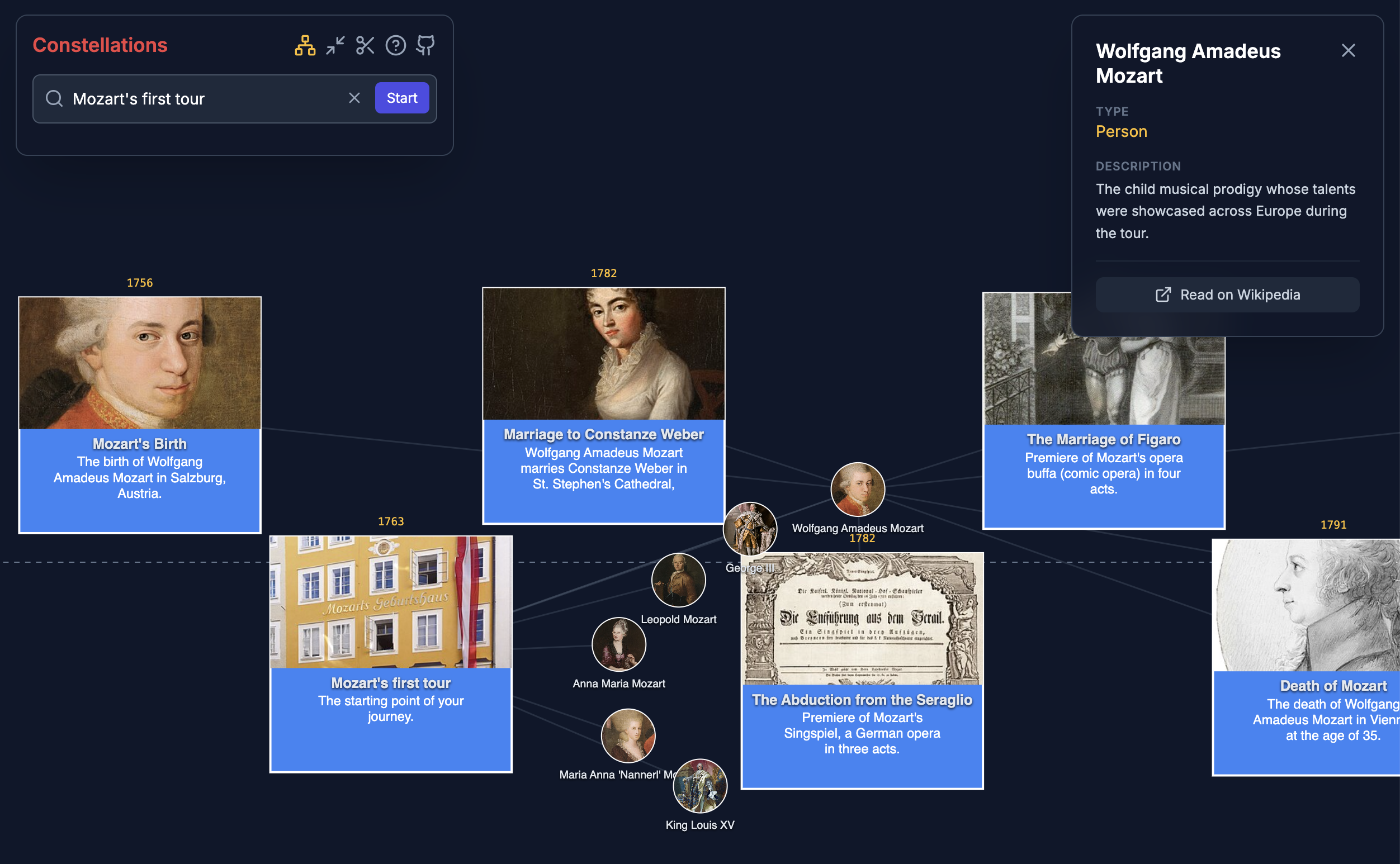
I want to generate collaboration graphs of world history. The edges are people who have wikipedia pages. The nodes are things that bring people together: one-on-one meetings, projects, movies, battles, schools, and so on. I want to start with some node, like the movie Godfather, and follow the careers of the people who collaborated on it to other nodes. I want to see it as a graph and be able to wander around in the space.
The core features were working that afternoon.
The idea was to be lazy and create collaboration graphs on the fly. No database, just live LLM queries. The whole graph exists nowhere. Construct a local neighborhood around a given node and expand out from there. Slower but now it works on anything. One constraint -- the people have to have wikipedia pages.
Would the model be able to find the people involved in an event and the events for a person? I'm defining an "event" as anything that involves at least 2 people at a given time or time range. Results are not bad and should get better.
Soon I realized that people are nodes not edges. A person is a hub of events, an event is a hub of persons. The edges connect people with the events they participated in. There should be no people-to-people or event-to-event connections. No dups.
Google AI Studio had a great start but I pushed it too far and it took a wrong turn. I wanted to undo the day's work. The agent was handling github checkins for me, but it was unable to revert to main.
So I liberated the project from AI Studio and switched to Antigravity, which was fine until I used up my quota. Turned to Cursor where I have a paid account. Cursor is the weakest link. Lots of errors. It sometimes finds the best solution but only after it has exhausted all the alternatives.
Five days later, I thought it was done and posted it for some friends.
But save/restore and export/import were needed for sharing graphs. That took one evening. Cursor ended up doom looping so it was off to Codex, a step up from Cursor but not cheap. Fortunately there was not much left to do, about 3 bucks.
I spent the rest of the week looking for good examples, tweaking the image queries, updating help, and just playing with it.
It currently gets images by querying Wikipedia Commons rather than requesting images from the LLM, which Cursor claimed would be too error-prone. I'm not sure. Lots of errors this way.
Stylewise, I try to present the agent with problems and keep whatever changes I have in mind to myself, at least until I see what it comes up with. Next time I will save all non-trivial prompts, something the tools do not do well.
D3 is the graph engine. The code builds a force-directed layout with D3 forces (forceSimulation, forceLink, forceManyBody, forceCenter, collisions, zoom/drag).